My Enceladus Research Journey: Building a Scientific Study from Scratch

This page is for me to record the process of creating my very first research paper, on the evolutionary adaptations and characteristics life would have to have to survive on one of Saturn’s moons, Enceladus.
Rather than only presenting final conclusions, this blog captures the full research process, including how my ideas evolved, how I designed my methodology, and how I interpreted scientific data.
The goal is to make the process of scientific research more transparent and accessible, especially for students interested in astrobiology or any related research like me.
Why Enceladus?
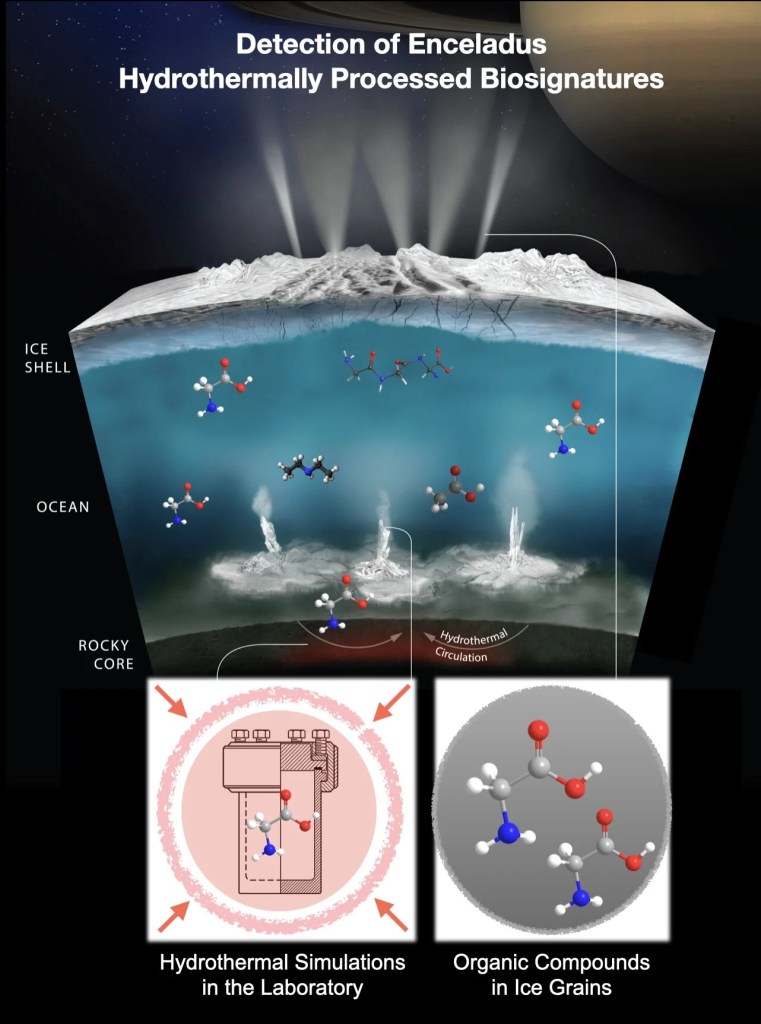
Enceladus is one of the most promising locations in the solar system for the search for life beyond Earth. Data from NASA’s Cassini mission revealed water rich plumes containing hydrogen, organic compounds, and salts strong evidence of a subsurface ocean and possible hydrothermal activity.
These conditions are similar to deep-sea hydrothermal vents on Earth, where life exists without sunlight, relying on chemical energy instead.
Research Question
I started with one curious question. If life exists in Enceladus’ hydrothermal ocean, what would its ecosystem and food web look like, and which shared morphological and physiological traits would organisms need in order to survive?
Why Enceladus?
This question guided the entire direction of my research and helped define the parameters I focused on, including temperature, pH, pressure, and energy sources.
Brainstorming
At the beginning of this project, I focused broadly on whether life could exist on Enceladus. However, as I continued researching, I realized that the more important question was not just the possibility of life, but what that life would look like and how it would function.
This led me to shift my approach toward comparing Enceladus conditions with Earth-based extremophiles and identifying which traits are necessary for survival in extreme environments.
Methodology
To investigate this question, I selected extremophile species from Earth that live in hydrothermal vent environments and compared them against the inferred conditions of Enceladus’ ocean.
Each species was evaluated based on key environmental parameters:
- Temperature tolerance
- pH tolerance (alkalinity)
- Pressure tolerance
- Redox conditions
I then developed a scoring system to rank how compatible each organism is with Enceladus-like conditions.
Three-dimensional habitability model for Enceladus hydrothermal environments.
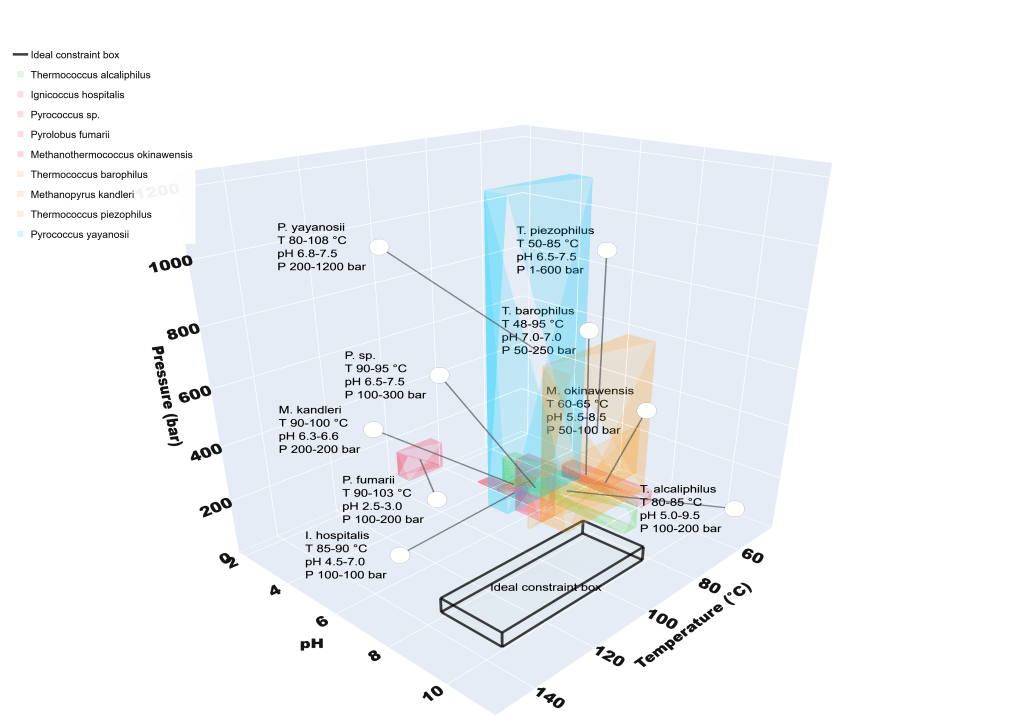
The cube lustrates the modeled environmental ranges of temperature (90–140 °C), pH (8.5–10.5), and pressure (80–130 bar). Shaded regions represent the tolerance ranges of extremophilic organisms, while labeled species indicate representative analogs. The outlined “ideal habitability zone” highlights the subset of conditions most compatible with microbial survival under Enceladus-like constraints.
Key Findings
The results showed that temperature and pressure conditions on Enceladus are broadly compatible with several known extremophiles. However, high alkalinity (pH) emerged as the most restrictive factor. Oxygen was not a limiting factor as many extremophiles survive anaerobic conditions.
While some organisms showed partial compatibility, none perfectly matched all environmental conditions. This suggests that life on Enceladus, if it exists, would likely require specialized adaptations beyond those observed in Earth analogs.
Proposed Microbial Ecosystem
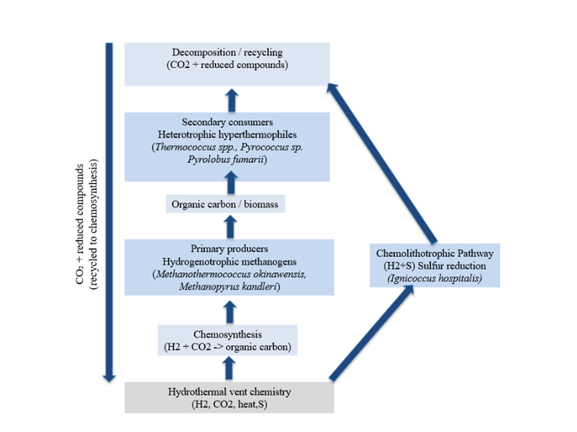
Based on the highest-ranking organisms, I developed a simplified model of a hydrothermal vent ecosystem on Enceladus.
In this model:
- Chemosynthetic microorganisms (such as methanogens) act as primary producers
- Heterotrophic archaea function as secondary consumers
- Additional microbes contribute to nutrient recycling
This type of ecosystem would be entirely independent of sunlight and driven by chemical energy from hydrothermal activity.
Interactive Model
https://adityaangadi-cosmos.github.io/Enceladus-Survival-Compatibility-Cube/
Challenges & What I Learned
One of the biggest challenges in this project was understanding how multiple environmental factors interact. Initially, I underestimated the importance of pH, but further research showed that high alkalinity can significantly limit biological processes.
I also learned that scientific research is not a linear process. My ideas evolved as I encountered new data, and I had to revise my assumptions multiple times.
Final Reflection
This project helped me understand how scientists build knowledge through evidence, comparison, and revision. It also showed me that even when direct data is limited, models and analogs can be used to explore complex scientific questions.
In the future, I would like to expand this research by incorporating energy modeling and exploring how these ecosystems could be detected by future space missions.

